Introduction
For many businesses, email infrastructure starts with basic shared hosting environments. While shared email hosting may work during the early stages of a business, operational growth often introduces challenges related to deliverability, security, scalability, and infrastructure control.
As communication becomes increasingly critical for daily operations, businesses begin evaluating whether dedicated mail infrastructure offers better long-term reliability and operational flexibility.
This article compares shared email hosting and dedicated mail infrastructure from both technical and business perspectives to help organizations understand which approach aligns better with their operational requirements.
What Is Shared Email Hosting?
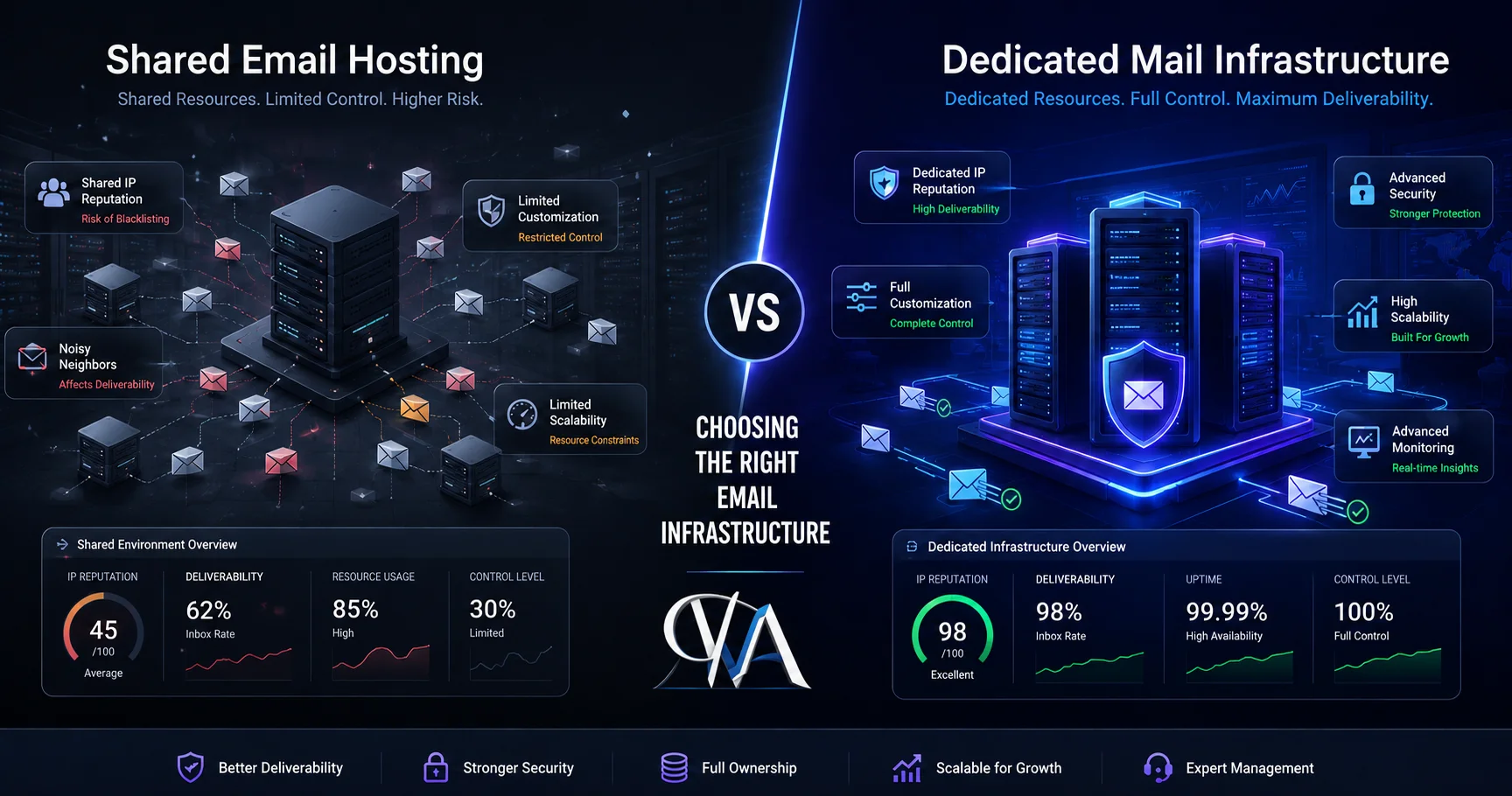
Shared email hosting refers to an environment where multiple businesses and domains operate on the same underlying mail infrastructure.
In most shared environments:
- server resources are shared across multiple users
- IP reputation is shared
- security policies are standardized
- custom infrastructure control is limited
- mail routing flexibility is restricted
This approach is commonly used because of its lower entry cost and simplified management.
However, shared environments can introduce operational limitations as businesses scale their communication systems.
What Is Dedicated Mail Infrastructure?
Dedicated mail infrastructure provides businesses with isolated email systems configured specifically for their operational requirements.
Instead of sharing infrastructure resources with multiple organizations, businesses operate on dedicated server environments with greater control over security, deliverability, routing, monitoring, and scalability.
Dedicated infrastructure typically allows:
- dedicated server resources
- customized mail routing
- advanced security configurations
- better reputation management
- improved monitoring capabilities
- greater operational flexibility
This model is commonly adopted by growing businesses, SaaS platforms, operational teams, and organizations handling higher communication volumes.
Shared Hosting vs Dedicated Infrastructure
| Factor | Shared Email Hosting | Dedicated Mail Infrastructure |
|---|---|---|
| Infrastructure Control | Limited | High |
| Security Flexibility | Standardized | Customizable |
| IP Reputation | Shared | Dedicated |
| Deliverability Optimization | Limited | Advanced |
| Monitoring & Visibility | Basic | Detailed |
| Scalability | Moderate | High |
| Custom Routing | Restricted | Flexible |
| Operational Ownership | Low | High |
Common Problems With Shared Email Hosting
Many businesses eventually encounter limitations when relying entirely on shared email environments.
Shared IP Reputation Risks
If other users on the same infrastructure engage in spam activity or poor mailing practices, overall IP reputation can be affected, impacting inbox placement for unrelated businesses.
Limited Security Customization
Shared systems generally offer limited control over advanced firewall rules, routing logic, filtering systems, and infrastructure-level security policies.
Restricted Operational Flexibility
Businesses may face limitations when implementing custom workflows, transactional email systems, routing policies, or advanced monitoring requirements.
Scalability Challenges
As communication requirements grow, shared environments may struggle to provide the flexibility and performance required for larger operational workloads.
When Should Businesses Consider Dedicated Mail Infrastructure?
Dedicated infrastructure becomes increasingly valuable when:
- email communication becomes operationally critical
- deliverability issues begin affecting business operations
- organizations require greater security control
- transactional email systems are introduced
- teams scale communication workflows
- compliance or monitoring requirements increase
- businesses require infrastructure ownership
Is Dedicated Infrastructure Necessary for Every Business?
Not necessarily.
Smaller businesses with minimal communication requirements may operate effectively within professionally managed shared environments during early growth stages.
However, businesses with growing operational complexity, larger teams, transactional systems, or infrastructure-sensitive communication workflows often benefit significantly from dedicated mail infrastructure.
Final Thoughts
Choosing between shared email hosting and dedicated mail infrastructure is ultimately a decision about operational control, scalability, security, and long-term communication reliability.
While shared hosting environments may provide a simple starting point, dedicated infrastructure offers greater flexibility and ownership for businesses requiring more advanced communication systems.
Organizations evaluating their email infrastructure should consider not only current requirements, but also future operational growth, security expectations, and communication reliability needs.
Need Professional Email Infrastructure?
Explore our managed business email hosting and dedicated mail infrastructure solutions designed for growing businesses and operational teams requiring secure, professionally managed communication systems.